

Image Description: HOW WE MOVE logo in black text and an red ‘W’ and purple ‘M’ hugging.
Media Contact:
Mariclare Hulbert, PR Contact for Embraced Body
mariclare.hulbert@gmail.com
585.278.2302
EMBRACED BODY ANNOUNCES HOW WE MOVE PROGRAM COHORT TWO PARTICIPANTS
– Six Dancers Will Participate in This Intensive For Multiply Marginalized D/deaf and Disabled Artists –
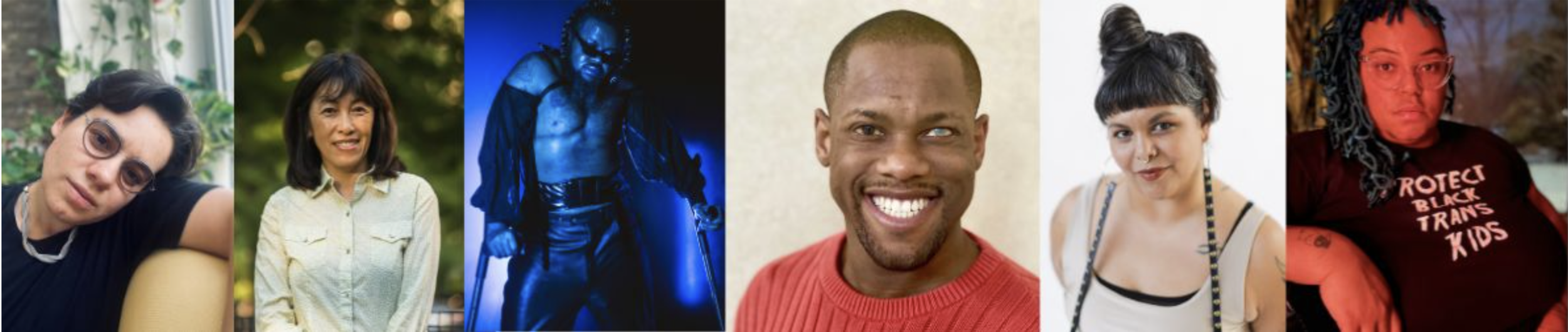
Left to Right: Ariana Martinez, Miwa Nagura McCormick, Uhuru Moor, Davian DJ Robinson, Taja Will, foster weems. Image descriptions and photographer credits at the end of release.
Phoenix, AZ (August 5, 2025) Embraced Body, the Disability Justice and inclusive arts organization founded by artist and Disability Justice consultant India Harville, announces participants for Cohort Two of its How We Move program. Funded by the Mellon Foundation, How We Move is a dance intensive created for and by multiply marginalized D/deaf and Disabled artists; the program centers agency, multiplicity, interdependence, and creative power. The artists of Cohort Two are: Ariana Martinez (The Bronx, NY), Miwa Nagura McCormick (New York, NY), Uhuru Moor (Los Angeles. CA/New Orleans, LA/New York, NY), Davian DJ Robinson (Charlotte, NC), Taja Will (Minneapolis, MN/Mni Sota Makoce), and foster weems (Philadelphia, PA).
“In our first year of How We Move, we witnessed what becomes possible when multiply marginalized Disabled artists gather in a space built with collective access at its core. The artists in our inaugural cohort came together across multiple disabilities and identities, and many spoke about the profound impact of being in a space where they were no longer the ‘only’ Disabled, QTBIPOC dancer in the room. Care became choreography, difference became generative, and artists were able to explore their practices in community, demonstrating how access itself can become an artistic practice,”shares India Harville, Embraced Body Founder & Executive Director.
Harville continues, “The How We Move level of care and access offers a living template for the kinds of artistic spaces participants want to build in their own communities. In Cohort Two, we are deepening this work—cultivating cross-disability solidarity and expanding a community of Disabled dance artists shaping the future of the field together.”
The How We Move Program centers D/deaf and Disabled, multiply marginalized (BIPOC, LGBTQIA+) dancers. In its second cohort, the program welcomes six artists and includes four virtual gatherings, followed by a 10-day in-person intensive in New York City, and culminating in a final virtual gathering. This hybrid gathering format intends to provide multiple access points to Disabled dance artists wishing to build and expand cross-disability community.
How We Move will shift the timeline of its Cohort Two program, with the in-person residency now scheduled for Summer 2027. The adjustment reflects the organization’s commitment to disability culture, access, and care in response to evolving health, caregiving needs, and family loss within the team.
“The decision to shift the timing of our Cohort Two intensive is the embodiment of all that we value about disability culture and access. We are committed to moving at the pace of care and to sustaining meaningful support for the artists involved,” comments Harville.
The in-person intensive will include somatic/movement/dance workshops; each participant will have an opportunity to lead a workshop and will receive support to ensure their workshop is accessible for all attendees. The intensive will also include space to build power together towards a transformation of the colonial, eugenicist, and ableist lineages still present in the dance field. This intensive will provide a rigorous access framework, allowing cross-disability artists from across the country the opportunity to come together, create, learn from one another, and cultivate opportunities. Participants receive a $2,000 stipend and the program will cover access, travel, housing, and food costs for the June in-person intensive. Funding is also available for Personal Care Attendants.
The inaugural How We Move program took place in 2025; artist participants included Assaleh Bibi, kumari giles, Devin Hill, Hector Machado, Jackie Robinson, and Zen Spencer.
How We Move collaborators include India Harville, Kayla Hamilton, and JJ Omelagah; Movement Research is a venue partner.
ARTIST PARTICIPANT BIOS
Ariana Martinez (they/them) is a queer, nonbinary artist of Puerto Rican descent working across sculpture, installation, and time-based media. Ariana’s geographic lineage spans the Midwest, Northeast, and Southern United States with present, familial homes in Lajas, Puerto Rico and Bronx, New York. Ariana uses their practice to understand how processes of spatial navigation and sensory perception are altered by displacement, debility, and ecological change. As a disabled artist living with neurological and autoimmune illnesses, Ariana works to challenge notions of distanced self-sufficiency and instead make space for a diversity of embodied and relationships to movement, land, and place. Ariana holds an M.F.A from Rutgers University’s Mason Gross School of the Arts, a B.F.A in Sculpture from Rhode Island School of Design and a B.A. in Urban Studies from Brown University. They are the Art Director and among the Founding Editorial Board Members of Sound Fields, a publication about audio documentary, in theory and in practice. Ariana’s work has appeared at the Open City Documentary Festival (UK), the Barbican Cultural Center (UK), the Third Coast International Audio Festival (USA), LUCIA Festival (Italy), and the Hearsay Audio Arts Festival (Ireland). In 2018 they received the inaugural Signal to Noise Award from Union Docs and Gilded Audio, and has since been an artist in residence at The Steel Yard (RI); Arts, Letters, & Numbers (NY), The Ragdale Foundation (IL), The James Castle House (ID), the Haystack Mountain School of Crafts (ME) and the Virginia Center for Creative Arts.
Miwa Nagura McCormick (she/her) hails from Japan, where she got her dance bug while training in synchronized swimming as a child. She then started taking jazz dance classes and founded a jazz dance club in college. At UC Berkeley, where she studied molecular biology as an exchange student, she encountered modern dance through its dance department, founded by former Graham dancers David and Marnie Wood, and took daily dance classes there. Subsequently, she moved to NYC in 1991 to immerse herself in dance. The teachers who shaped her dance technique include David Storey, Lynn Simonson, Laurie DeVito, Diane McCarthy, and Tee Ross. She is also certified to teach the Simonson Technique. She performed in dances choreographed by David Storey, Donna Thomas, and Lisa Cluth, among others.
Professionally, she has over 30 years of experience producing and directing TV programs and has featured many choreographers, dance companies, and performances in the TV series of the Japanese public broadcasting network. Since her diagnosis of neurodegenerative movement disorder in 2019, she shifted her focus to produce stories about disability advocacy and inclusion. Her documentary about Ava Xiao-Lin Rigelhaupt, Broadway’s first Autistic Creative Consultant in the musical How to Dance in Ohio, won the 2024 Telly Silver Award in the DEI: Diversity, Equity & Inclusion category.
Miwa has a BA in Biology from International Christian University and an MA in Performance Studies from New York University. She is thrilled to participate in the How We Move program after 23 years of hiatus from performing.
Uhuru Moor (he/him) The Uhuruverse is THE FREE UNIVERSE, an alternate spacetime/reality in which the universe (everything; the totality: space, time, matter and energy) is FREE/experiences freedom. As Uhuru means freedom in Swahili and "universe" comes from the Latin word universus, which is a mixture of the words versus (turned) and uni (one). Combined they form universus, which literally means “turned into one“. The Uhuruverse is a PROTEST ARTIST who uses multiple mediums and performance styles to speak against oppression and demand and encourage liberation.
As a musician, The Uhuruverse can be best described as experimental. Best known as the electric guitarist for the band Fuck U Pay Us (a four piece Black tgnc, queer, femme punk band demanding land reparations for the African Holocaust and free self defense training for tgnc & femmes),The Uhuruvese also raps and is infamous for live/improv performance. The artist enjoys exploring 4 other genres including but not limited to: Hip Hop, Punk, Funk, Disco, Vogue, Blues, Jazz,J Pop and New Jack Swing.
The Uhuruverse spliced together their own, original dance style that combines Burlesque and Butoh. The dancer uses burlesque and nudity in protest for queer sexual liberation and gender nonconformity. Butoh’s founder created the dance to mourn Japanese deaths in World War II. The Uhuruverse performs the “dance of death” to honor those slain during the African Holocaust.
The Uhuruverse performs drag and invokes interactive art and improvisation in their live performances. The Uhuruverse is a producer and curator of live shows that include mixed media and live performers. In 2016 The Uhuruverse directed the psychedelic film noir, “FIGHT IN HEELS”, a collaboration with the #SNATCHPOWER artist collective and directed a follow up second film in 2018 titled “Channeling Calafia (a pre-colonial/post-apolcalyptic short film about a Black indigenous leader of California). The Uhuruverse released their first music album in 2018 titled “The Brightest Oddest Strangest Star U Ever Did Saw Up Close and Afar From Planet Earth to Mars and Beyond.” They released their second album exclusively in 2019 titled “Who Killed Kenisha?!” And did their first immersive installation titled “Nightmare on Easy Street” in Folkestone, England critiquing the classism of fascism. The Uhuruverse founded #SNATCHPOWER in 2014.
Common Themes in The Uhuruverse’s Work:nature, Black/indigenous futurism, LGBTQIA/Black/poor/disabled inclusivity, goth/lolita/kawaii fashion, Satanism (anti-Christianty/christendom), recycling, anti-capitalism/ MINIMALISM, and anti-governnment/state/politics/policies.The Uhuruverse established The Deeepspacecraft in 2020 (a Black disabled tgnc owned and operated sanctuary space) in New Orleans, LA. The space has gone on to house over 35 Black trans folks in need and/or for creative purposes.
Davian DJ Robinson (he/him) is a passionate and boundary-breaking visually impaired dancer, choreographer, and performer. Drawing from his lived experience and athletic movement style, he creates choreography that is both physically powerful and emotionally resonant. His work blends dynamic storytelling with raw embodiment, inviting audiences into a world where rhythm, resilience, and adaptability redefine how we move and connect. Through both performance and education, Davian challenges conventions and opens new possibilities for inclusive expression in the arts.
foster JANAE weems (she/they) is a fat black queer and trans interdependent-disciplinary artist and educator whose life and work takes cues from the black baptist church, black queer kink community and an ever-expanding adoration of witnessing the capacious and audacious embodiments of the black imagination. foster is a dancer of the black improvisational dance tradition, a painter, composer/arranger and photographer who works to create care-driven spaces for ushering fat black queer and trans folks into play, experimentation, unbridled being and, ultimately, a deepened intimacy with- and trust of themselves, their desires and creative visions. foster is a 2025 NC Dance Festival Artist-in-Residence and 2026 Raleigh Arts Performance Fellow, a 2024 Grounded Possibilities Fellow and 2024 BLK Transcendence SEEDS Writing Fellow. They are the facilitator of Black Intimacy Practice (a body-centered space for fat black queer and trans artists, healers and dancers) and the founder/co-steward of Play Church (a co-op by and for black queer and trans artists, organizers and healers).
Taja Will (they/them) is a non-binary, chronically ill, queer, Latinx (Chilean) adoptee. They are a performer, choreographer, somatic therapist, consultant and Healing Justice practitioner based in Mni Sota Makoce, on the ancestral lands of the Dakota and Anishinaabe. Taja’s approach integrates improvisation, somatic modalities, text and vocals in contemporary performance. Their aesthetic is one of spontaneity, bold choice making, sonic and kinetic partnership and the ability to move in relationship to risk and intimacy. Will’s artistic work explores visceral connections to current socio-cultural realities through a blend of ritual, dense multi-layered worldbuilding and everyday magic. Taja initiates solo projects and teaching ventures and is a recent recipient of the 2021 Jerome Hill Artist Fellowship and 2018-’19 McKnight Choreography Fellowship. Their work has been presented throughout the Twin Cities and across the United States. They have led the Taja Will Ensemble for 10 years and is currently working on a new ensemble performance ERODE, to premiere in 2027 at the Red Eye Theater. In addition to dance Taja is a Healing Justice practitioner, consultant, coach, educator and ritualist. They center Disability Justice, nervous system awareness, embodiment and relationship-building in all they do.
COLLABORATOR BIOS
About Embraced Body
Centered in the belief that our bodies should feel radically welcomed in all spaces, Embraced Body advances Disability Justice through inclusive performing arts, accessibility consulting, and anti-ableist education for all. Our work is for and by people like us: Black Disabled people, queer and genderqueer Disabled folks, Disabled survivors, folks who don’t neatly fit into one identity category or one canonized way of making dance—those who need to re-make the world in their image in order to find a place where they can be in their entirety. Embraced Body is driven by a profound commitment to fostering accessibility and inclusivity for multiply marginalized Disabled individuals. By highlighting the interconnectedness of ableism with other forms of oppression and addressing these systemic inequalities head-on, we endeavor to dismantle oppressive structures and create a more equitable society for all.
India Harville
As a Disability Justice activist, performance artist, public speaker, and somatics practitioner, India Harville (she/her) has made it her mission over the past 20 years to open people's minds to the wonder of their own bodies as a vehicle for growth and transformation, both personal and collective.
India has danced with Sins Invalid, Dance Exchange, California State East Bay, The Queer Arts Festival, the Black Spirit Dance Collective, Mouthwater Festival, and Movement Liberation. She’s a two-time recipient of the Access Movement Play Residency funded by Mellon and is currently working on a one-woman show, Liminal. She’s certified as a dance instructor in: NIA, Zumba, Dancing Freedom, and DanceAbility, where she is both a Master Teacher and Master Trainer.
In 2016, she founded what is now known as Embraced Body, a Disability Justice and inclusive arts organization that began by providing accessible movement classes to Disabled communities. Since then, they’ve made disability-affirming dance funded by major philanthropic organizations, while also consulting on accessibility and Disability Justice.
The intersection of India’s own identities as an African American, queer, Disabled/chronically ill, femme, cis woman informs all her work. No matter what she is doing, she sets forth the example that however our bodies show up in the world, they are perfect, worthy of existence, and capable of magic.
Kayla Hamilton
Kayla Hamilton (she/they) is a Texas-born, Bronx-based dancer, performance maker, educator, consultant, and artistic director of Circle O—a cultural organization uplifting Black Disabled and other multiply marginalized creatives.
She has developed & designed access-centered programming for the Mellon Foundation, Movement Research, DanceNYC, and UCLA, and is a co-director of Angela’s Pulse/Dancing While Black.
Kayla is a Jerome Hill Artist Fellow, Pina Bausch Foundation Fellow, United States Artist Disability Futures Fellow, NEFA National Dance Project Production Grant recipient, and Bronx Cultural Visions Fund recipient. Her work has been presented at the Whitney Museum, Gibney, Performance Space NY, New York Live Arts and Bronx Academy of Arts and Dance. Kayla was also part of the Bessie award winning ensemble Skeleton Architecture.
As an educator, Kayla co-developed ‘Crip Movement Lab’ with fellow Disabled artist Elisabeth Motley—a pedagogical framework centering cross-disability movement practices. She also worked as a K-12 public school special education teacher in NYC for 12 years.
JJ Omelagah
JJ Omelagah (they/them) is the Program Director, Access Doula, and Healing Artist for Embraced Body and the founder of Sounds of Kayode.
With two decades of experience in human services and healthcare, JJ brings a unique perspective on care. They provide crucial access support and education while contributing to the organization's overall operations.
As a transgender sound artist, JJ’s mission is to create vibrant frequencies resonating with collective care, healing, and transformation. Each note contributes to the co-creation of a sonic environment where energies converge, intertwine, and uplift. They’ve performed at events such as SF Pride and the National Queer Arts Festival.
JJ studied at Howard University and City College of San Francisco and holds a certification in Project Management from the University of Arizona. They are also a trained Circle Sing Facilitator, Reiki practitioner, Orisha priest, and a committed advocate for Disability Justice and LGBTQIA+ rights. With comprehensive experience in Access Doulaship, project management, customer service, case management, conflict resolution, and volunteer management, JJ brings a wealth of knowledge to their work in access, care, and community building.
Movement Research
Movement Research, founded in 1978, is one of the world’s leading laboratories for the investigation of dance and movement-based forms. As a creative incubator for artists and emerging ideas, Movement Research provides space and resources for adventurous dance. Valuing the individual artist, their creative process and their vital role within society, Movement Research is dedicated to the creation and implementation of free and low-cost programs that nurture and instigate discourse and experimentation. Movement Research strives to reflect the cultural, political and economic diversity of its moving community, including artists and audiences alike.
In January 2019, Movement Research moved into its first permanent home at 122 Cultural Center. In 2024, Movement Research broke ground on the build-out of its two studio spaces located in 122CC to create: two dance studios to house MR programs and to serve artists and the community with subsidized rates for rehearsals, practice and convenings; a vestibule outside of the studios that offers a space to gather, stretch and converse; a resource room to provide meeting and lounge space for artists, and access to MR’s library and publications.
Funding Credits
The How We Move program is funded by the Mellon Foundation. Embraced Body is fiscally sponsored by Dancers' Group and is grateful for funding support from Mellon Foundation, Solidaire Network and Borealis Philanthropy.
Image Descriptions:
Headshots, left to right.
Ariana, a Puerto Rican, nonbinary person with light skin and short, dark brown hair looks calmly into the camera. Ariana wears a black t-shirt and round eyeglasses with lenses tinted a soft, pale violet. Ariana rests their head on their arms while sunlit brick walls and greenery extend behind them. Photo courtesy of artist.
An Asian woman with dark brown hair standing outside, near trees, wearing a light green, patterned shirt. Photo by John McCormick.
Uhuru is standing in a blue-lit room, wearing black mesh sleeves, his chest out, leather pants, and a corset, with his arm crutches. He has thick locs with silver wrap on them, and sunglasses. Photo by Rey Broughton.
A professional headshot of Davain, a smiling man facing slightly toward the camera against a soft, neutral beige background. He is wearing a bright red knit sweater with a ribbed texture. His hair is closely cropped, and he has a neatly trimmed mustache and goatee. His expression is warm and confident, with a broad smile showing his teeth. One of his eyes appears clear while the other appears cloudy, suggesting visual impairment. The lighting is soft and even, highlighting his facial features and creating a polished, approachable portrait. The overall tone of the image is friendly, professional, and welcoming.
A non-binary femme with cinnamon toned skin gazes up into the camera with a soft presence. Their long hair is bunned on the top of their head and they have dark brown bangs streaked with silver. They have adorned themself with gold nose piercings and statement earring that reach from their ears down past their shoulders, their skin is artfully tattooed and they are wearing a white silver tanktop delightfully contrasting deep red lipstick. Taja Will; photo by Isabel Fajardo.
foster weems, a fat lightskinned black person, sits in the foreground under a red-orange light. they are sitting sideways in a leather chair and their arm is draped over the chair back causing their right hand to rest in front of them at chest height; a bunny tattoo is visible on their right wrist. they are wearing a black shirt with the sleeves rolled up in an exacted cuffed. the shirt reads "protect black trans children" in white lettering that is stretching and beginning to peel in places. the shirt is cropped, revealing their tattooed belly rolls. their round face dons a light mustache, a double chin with a patchy light beard, clear cat eye framed glasses and a hoop in their right nostril. their turquoise locks drape over their right shoulder. they also have bangs cut above their temple. in the background of the photo, the leaves of a snake plant are visible, but blurry and through the window, bare trees, an evergreen and snow (on the ground) are visible.
###